
Compare design options
25% more span, about 144% more deflection: compare the same IPE 300 beam at 6 and 7.5 metres and understand what changes.
A practical task
Does the same section still meet your target at a longer span? Compare two simply supported beams. Keep the section, material and load per metre fixed. Change only the span.
Inputs & targets
- Span
- A: 6 m · B: 7.5 m
- Section / material
- IPE 300 / S235, major axis
- Stiffness
- E = 210,000 N/mm² · I = 8,356 cm⁴
- Total uniform load
- 12 kN/m including self-weight, without additional load factors
- Example target
- Deflection at most L/300
How to proceed
Establish the baseline
Define supports, section, stiffness and total uniform load. Calculate the 6 m option first.
Change the span
Increase only the span to 7.5 m. Keep IPE 300 and the load per metre of 12 kN/m.
Interpret the results
Compare moment, deflection and the limit for each span. Keep the deflection assessment separate from resistance and stability.
USC-000002
Same section. Much greater deflection.
The longer option exceeds the chosen deflection target. Although the span increases by only 25%, deflection increases by about 144%. The following values were independently checked analytically.
| Result | Option A | Option B | Unit |
|---|---|---|---|
| Span L | 6.0 | 7.5 | m |
| Reaction at each support qL/2 | 36.00 | 45.00 | kN |
| Maximum moment qL²/8 | 54.00 | 84.38 | kNm |
| Maximum deflection w | 11.54 | 28.17 | mm |
| Example limit L/300 | 20.00 | 25.00 | mm |
| w / (L/300) | 0.577 | 1.127 | 1 |
A: example target met
11.54 mm ≤ 20 mm
B: example target exceeded
28.17 mm > 25 mm
This assessment only addresses w ≤ L/300. It does not establish beam resistance or stability.
Why the difference is so large
For the same load per metre and flexural stiffness, moment scales with L² and deflection with L⁴. The span ratio 7.5/6 = 1.25 therefore gives 1.5625 times the moment and 2.4414 times the deflection. The example limit L/300, however, increases by only 25%.
w = 5qL⁴ / (384EI)
q = 12 N/mm · E = 210000 N/mm² · I = 83560000 mm⁴
The load per metre stays constant. The longer beam therefore carries a total applied load of 90 kN instead of 72 kN. A comparison with the same total force in kN would be a different task.
The comparison in CALC
These excerpts were captured from the live CALC example on 17 September 2026. CALC calculated the values analytically using Python. The table and deflection values agree with the independent reference calculation.


The CALC diagrams are schematic and scaled separately. Compare the numerical values, not the drawn curve heights. The captures show the German interface.
What you can work with next
You can see why the longer option exceeds the chosen deflection target. Use this result to investigate a stiffer section or a different structural system next.
Scope & prerequisites
Analytical teaching example with a specified total uniform load and Euler-Bernoulli beam theory without shear deformation. L/300 is the chosen example target. Load combinations, actual serviceability requirements, resistance, stability and connections still require verification. No RFEM analysis or section optimization.
Read the workflow in the manualYour starter task for CALC
Compare two simply supported beams: option A with a 6 m span and option B with a 7.5 m span. Both use IPE 300 in S235, E = 210000 N/mm² and I = 8356 cm⁴ about the major axis. The specified total uniform load is 12 kN/m including self-weight for each option; do not add self-weight again. Calculate analytically using Euler-Bernoulli theory, without shear deformation, load factors or RFEM access. Execute the numerical calculation in Python. Tabulate support reactions, maximum bending moment, maximum deflection, the example target L/300 and the ratio w/(L/300). Show moment and deflection diagrams for both options and the calculation steps. Explain the effects of L² and L⁴. The ratio assesses deflection, not resistance. Identify the remaining EC3, stability and serviceability checks.
Open example in CALCThe task is ready in the message field. Review it and send it when you are ready to start.
Watch the workflow
Video transcript
This silent 40-second explainer uses real CALC screenshots captured on 17 September 2026. It is an edited sequence, not a continuous screen recording. Both options use IPE 300, S235 and a total uniform load of 12 kN/m including self-weight. At a 6 m span, deflection is 11.54 mm, below the example target of 20 mm. At 7.5 m, it is 28.17 mm, exceeding the 25 mm limit. Moment scales with L² and deflection with L⁴. The diagrams are scaled separately. Resistance and stability still require verification; no RFEM analysis was performed.
The next step in your workflow

Voice & collaboration
Prepare a calculation with Mia by voice
Discuss a steel beam task with Voice Agent Mia. Clarify missing inputs and review the conversation in chat before requesting a calculation.
Explore the example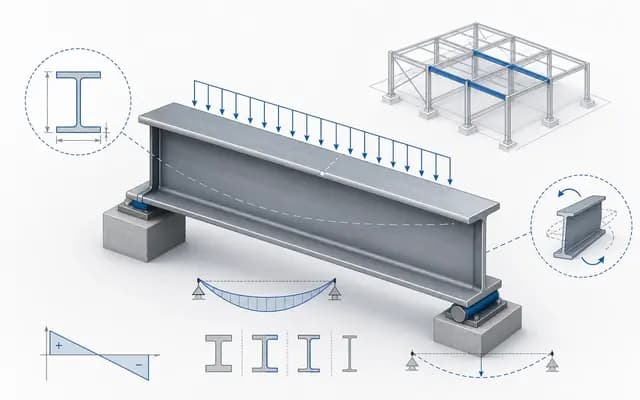
Concept & design
Size a steel beam
Examine a 6 m IPE 300 steel beam in CALC. Screenshots and a video show the example and how to prepare for further work in RFEM 6.
Explore the example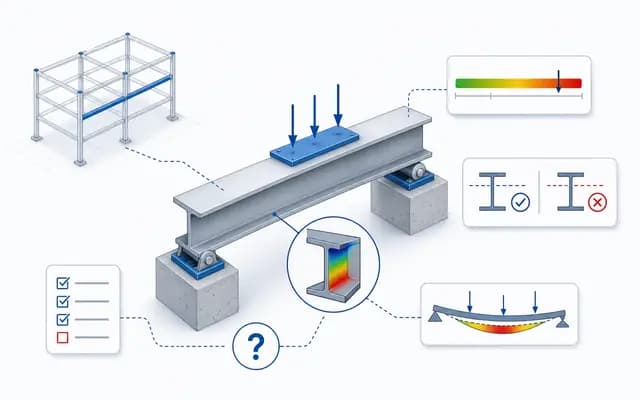
Documentation & handover
Create a calculation report
Bring results, inputs and assumptions together in an editable report and prepare it for PDF export.
Explore the examplePersonal workflows
Turn a proven chat workflow into a personal Skill
Save a proven workflow as a personal Skill. Use a facade panel fixing layout example to learn how to prepare the chat and review the resulting Skill.
Explore the example
Content updated: